





- April 8, 2026
- 0 Comments
If you’ve ever explored online advertising, you’ve probably come across this question: search vs display ads, which one should you choose?
At first glance, both seem similar. They’re part of the same platform, often run through Google, and both aim to bring in customers. But the way they work, and the results they deliver, are very different.
This guide breaks everything down in simple terms so you can understand not just the difference, but also what actually works for your goals.
What Are Search Ads?
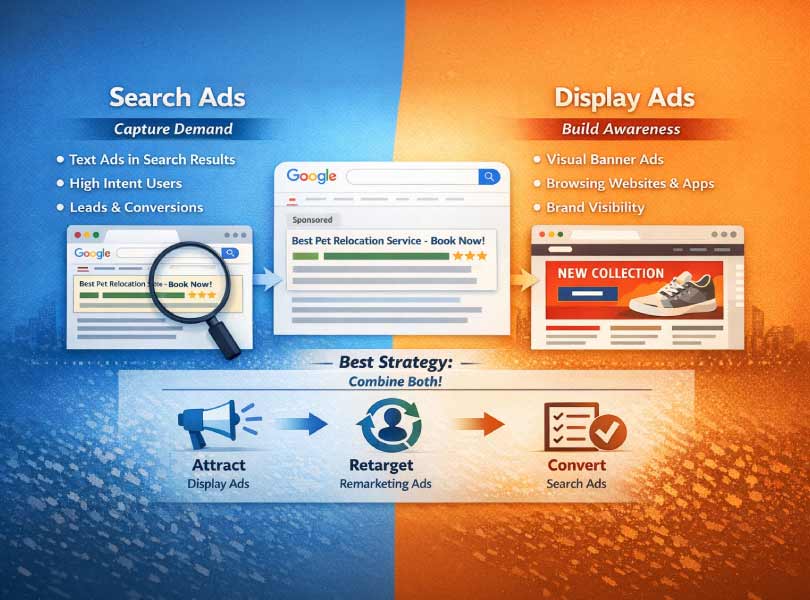
Search ads are the ads you see when you type something into Google. For example, if someone searches for “best pet relocation service”, the results at the top marked as “Sponsored” are search ads.
These ads are text-based and appear only when someone is actively looking for something. This is important because it means the user already has a need.
That’s why search ads are often linked to strong search ads ROI. You’re not interrupting someone, you’re showing up exactly when they’re ready to act. In simple terms, search ads help you capture existing demand.
What Are Display Ads?
Display ads are visual ads you see while browsing websites, apps, or even watching videos on YouTube. These can be banners, images, or short videos that appear when you’re reading an article or scrolling through content.
Unlike search ads, these don’t rely on someone actively searching. Instead, they show up based on interests, behavior, or demographics.
This is where the real display ads benefits come in. They help people discover your brand, even if they weren’t looking for it. Think of display ads as a way to create awareness rather than capture intent.
Search Ads vs Display Ads: Key Differences
Understanding the difference becomes easier when you look at how they behave in real situations.
| Feature | Search Ads | Display Ads |
|---|---|---|
| Trigger | User searches something | User is browsing content |
| Intent | High (ready to act) | Low (exploring or unaware) |
| Format | Text-based | Visual (images or videos) |
| Goal | Conversions, leads, sales | Awareness, visibility |
| Cost | Usually higher per click | Generally lower per click |
| Speed of results | Faster | Takes time to build impact |
This comparison is why most marketers don’t treat it as a competition. Each serves a different role.
Which One Works Better?
There isn’t a single answer, because “better” depends on what you’re trying to achieve.
If your goal is quick results, like getting leads or sales, search ads usually perform better. You’re reaching people who already know what they want.
But if your goal is to get noticed, build trust, or stay visible, display ads play a bigger role. They help you stay in front of potential customers over time.
So instead of asking which is better, a smarter question is: What does your business need right now, visibility or conversions?
When Should You Use Search Ads?
Search ads make the most sense when your audience is already searching for your product or service.
For example, a local service provider, an eCommerce store, or even a travel company can benefit from showing up at the exact moment someone is looking to book or buy.
Because of this, search ads are often the backbone of a performance-focused PPC campaign strategy. They bring in users who are closer to making a decision.
When Should You Use Display Ads?
Display ads work better when your audience doesn’t know you yet, or isn’t actively searching.
Let’s say you’ve just launched a new brand. People aren’t searching for you yet, so relying only on search ads may limit your reach.
Display ads help introduce your brand, remind users who visited your site earlier, and keep you visible across the internet.
One of the biggest display ads benefits is this ability to stay top-of-mind without depending on search behavior.
How to Use Both in a PPC Campaign Strategy
This is where things get interesting. The most effective campaigns don’t choose between search and display, they combine them.
A simple way to understand this is through the customer journey:
- At the beginning, people are just discovering options. Display ads help you appear in front of them.
- As they explore and compare, remarketing display ads remind them of your brand.
- When they’re finally ready to act, search ads capture that intent.
This layered approach turns your advertising into a full funnel instead of a one-step process. That’s why modern PPC campaign strategy often includes both formats working together.
Understanding Google Ads Campaign Types
If you’re running ads through Google, these fall under different Google Ads campaign types.
- Search campaigns show your ads on search engine results when users type specific keywords.
- Display campaigns place your ads across websites, apps, and YouTube within Google’s network.
Both are managed within the same platform, but they serve different purposes, one captures demand, the other builds it.
Search Ads ROI vs Display Ads ROI
When it comes to returns, search ads usually show results faster. Because users already have intent, conversion rates tend to be higher. This makes search ads ROI easier to measure in the short term.
Display ads, on the other hand, don’t always lead to immediate clicks or sales. Their impact builds gradually. Someone might see your ad today, remember your brand later, and convert days or weeks after.
So while search ads often win in direct performance, display ads support long-term growth.
Common Misunderstandings
A lot of confusion around search vs display ads comes from a few common assumptions. One is that display ads don’t convert. In reality, they do, especially when used for retargeting people who have already interacted with your brand.
Another is that search ads are always the best option. That’s not always true. If no one is searching for your offering yet, even the best search campaign won’t deliver results. Understanding the role of each helps avoid these mistakes.
Final Thoughts
Choosing between search and display ads isn’t about picking a winner. Search ads help you reach people who are ready to act. Display ads help you reach people who might act in the future. The real advantage comes when you use both with a clear plan.
If you’re focused only on immediate results, search ads can drive quick outcomes. But if you want steady growth’ and stronger brand recall, display ads add that missing layer.
In the end, the most effective strategy isn’t either-or. It’s knowing how each fits into your bigger picture, and using them accordingly.
FAQs
What is the difference between search ads and display ads?
Search ads appear when someone actively searches for something on Google, which means the user already has a specific need. Display ads, on the other hand, appear on websites, apps, or videos while people are browsing. The key difference is intent, search ads target users ready to act, while display ads focus on building awareness.
Which is better for ROI: search ads or display ads?
If you’re looking for quick conversions or leads, search ads usually deliver better results because they target high-intent users. This often leads to stronger search ads ROI in the short term. Display ads may not convert immediately, but they contribute to long-term growth by keeping your brand visible.
When should you use display ads in a PPC campaign strategy?
Display ads are useful when you want to introduce your brand, reach new audiences, or remind previous visitors about your business. In a well-planned PPC campaign strategy, they are often used at the awareness stage and for remarketing.
Do display ads actually convert or just build awareness?
Display ads do convert, especially when used strategically. While they are known for awareness, they work very well for remarketing, showing ads to people who have already visited your website. This increases the chances of conversion over time.
Can search ads and display ads work together?
Yes, and they often perform best when combined. Display ads can attract and nurture potential customers, while search ads capture them when they are ready to take action. Using both creates a more complete and effective approach across different Google Ads campaign types.