





- March 30, 2026
- 0 Comments
Search engines have changed more in the last few years than they did in the decade before. If you still think SEO is about inserting the “right keywords” into your content, you’re already behind. Today, Google doesn’t just read words, it understands meaning, relationships, and intent.
That shift has completely transformed how content should be created. This is where the debate of topic clusters SEO vs traditional keyword targeting becomes important. It’s not about choosing one and ignoring the other, it’s about understanding how modern SEO blends them into a smarter strategy.
Let’s break this down in a way that actually makes sense, whether you’re just starting out or refining an existing strategy.
What Are Keywords and Why They Still Matter
Keywords are the words or phrases people type into search engines. For example, someone might search “best SEO strategy” or “how to rank on Google.”
Earlier, SEO was heavily focused on finding these phrases and placing them in titles, headings, meta descriptions and content body.
This approach worked because search engines relied heavily on exact matches. But here’s the limitation: keywords alone don’t capture intent or context.
For example:
- “Apple benefits” could mean health benefits or company perks
- “Java tutorial” could refer to programming or coffee
Search engines now try to understand what the user means, not just what they type. That’s where modern strategies go beyond simple keyword usage.
What Are Topic Clusters in SEO
Topic clusters are a way of organizing content around a central theme instead of isolated keywords.
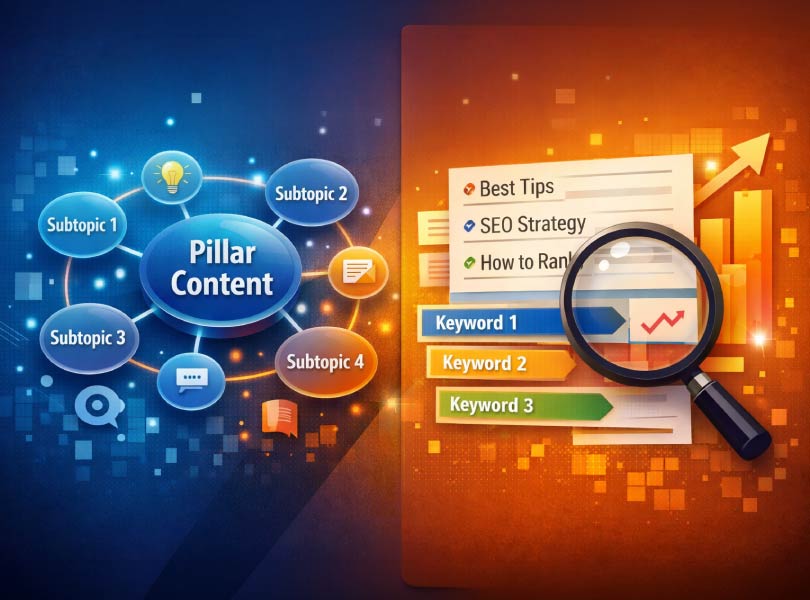
At the center, you have a pillar page that broadly covers a topic. Around it, you create multiple related articles, called cluster content, that dive deeper into subtopics. All of these pages are internally linked.
For example:
- Pillar Page: “Complete Guide to SEO Content Planning”
- Cluster Content:
- Keyword research basics
- On-page SEO techniques
- Content optimization tips
- Internal linking strategies
This structure signals to search engines that your website has depth and authority on a subject.
This is the core idea behind topic clusters SEO, you’re not just answering one query, you’re building a full knowledge system.
What Is a Pillar Page Strategy?
A pillar page is a long, comprehensive page that covers a broad topic at a high level. Think of it as the main hub. It doesn’t go extremely deep into every detail but provides a structured overview and links to detailed cluster articles.
A simple pillar page strategy looks like this:
- Choose a broad topic (e.g., “SEO content planning”)
- Create a detailed pillar page covering all major aspects
- Break subtopics into separate articles
- Link everything together logically
This creates a strong internal linking system, which helps both users and search engines navigate your content better.
Keyword vs Topic Strategy: What’s the Real Difference
Understanding keyword vs topic strategy is key to building modern content.
| Keyword Focused Approach | Topic Based Approach |
|---|---|
| Create one page per keyword | Build multiple pieces of content around a central theme |
| Optimize heavily for that keyword | Cover related questions and variations |
| Try to rank for that specific phrase | Focus on user intent rather than exact phrases |
Real World Example
Let’s say you run a fitness blog.
Keyword Strategy:
- One post targeting “weight loss tips”
- Another targeting “how to lose weight fast”
- Another targeting “fat loss guide”
These often overlap and compete with each other.
Topic Cluster Strategy:
- Pillar page: “Complete Guide to Weight Loss”
- Cluster posts: Diet plans, Exercise routines, Common mistakes, Supplements
Instead of competing pages, you now have a structured ecosystem that builds authority.
Why Traditional Keyword SEO Is Evolving
Search engines now use advanced systems like natural language processing and machine learning to understand content.
This shift has led to three major changes:
Context Matters More Than Exact Match
Google can understand synonyms, variations, and related concepts. You don’t need to repeat the same phrase unnaturally.
Search Intent Is a Priority
Content is ranked based on how well it solves the user’s problem, not how many times it uses a keyword.
Content Depth Signals Authority
A single article is no longer enough. Websites that cover a topic comprehensively tend to rank higher. This is why relying only on keywords is no longer effective.
How Topic Clusters Improve Rankings and Authority
When your content is interconnected and focused on a central theme, it sends strong signals:
- Your website understands the topic deeply
- Your content is structured logically
- Users can explore related information easily
This improves time spent on site, page relevance, and internal link strength. All of these contribute to better rankings. More importantly, it builds topical authority, which is becoming a major ranking factor.
The Role of Semantic Content SEO
Semantic content SEO focuses on meaning rather than exact wording. Instead of optimizing for a single keyword, you include related terms, contextual phrases, natural language variations.
For example, an article about “email marketing” might also include newsletter campaigns, open rates, automation tools, customer engagement.
This helps search engines fully understand the topic. It also makes your content feel more natural and useful to readers.
How to Build a Simple Topic Cluster Strategy
You don’t need a large team or complex tools to get started. A simple process works well. Start with one core topic relevant to your business.
Then:
- Identify 5 to 10 subtopics people commonly search
- Create one strong pillar page
- Write detailed articles for each subtopic
- Link all pages to the pillar and back
Keep your structure clean and intentional. Over time, expand your clusters instead of creating random, disconnected posts.
Modern SEO Content Planning: What Actually Works Today
Effective SEO content planning today is less about chasing keywords and more about building meaningful content ecosystems. Here’s what works:
- Focus on Topics First: Start with what your audience wants to learn, not just what they search.
- Map User Intent: Understand whether the user wants information, comparison, or action.
- Build Content Depth: Cover beginner, intermediate, and advanced aspects of a topic.
- Use Keywords Naturally: Keywords still matter, but they should fit naturally within context.
- Prioritize Internal Linking: Connect related content in a way that makes navigation easy.
This approach aligns with how search engines rank content today.
Conclusion
This isn’t really a competition. It’s an evolution. Keywords are still important, they help you understand what people are searching for. But topic clusters take it further. They help you build authority, improve structure, and align with how modern search engines work.
If you rely only on keywords, your strategy will feel fragmented. If you use topic clusters with a strong understanding of keywords, your content becomes more powerful, more relevant, and more likely to rank.
FAQs
What is the difference between topic clusters and keywords in SEO?
Keywords are individual search terms, while topic clusters organize multiple related pieces of content around a central theme to build authority.
Are keywords still important in modern SEO?
Yes, keywords still matter, but they should be used naturally within a broader topic-focused strategy.
What is a pillar page in SEO?
A pillar page is a comprehensive page that covers a broad topic and links to detailed articles on related subtopics.
How does semantic SEO improve rankings?
Semantic SEO helps search engines understand context and intent, making your content more relevant to a wider range of searches.
How many topic clusters should a website have?
Start with one strong cluster and expand gradually based on your niche and content capacity.